τ-chrono

Noise tracking for quantum circuits via Petz recovery maps.
26.4% more accurate on average. Wins at all 10 tested depths.

View on GitHub

The Result

We applied the Petz recovery map to predict quantum circuit noise. Validated on QuTech Tuna-9 superconducting hardware:

48.3%
More accurate noise prediction
at depth 50 (Tuna-9)
26.4%
Average improvement
across all tested depths
10/10
Depths where τ-chrono
beats independent model
0
Training circuits needed
~10 min from calibration data

Depth Scaling

τ-chrono prediction is closer to actual measured fidelity than the independent model at all tested depths. Improvement grows with circuit depth.

Experiment Details

All data from real hardware runs on QuTech Tuna-9 (9 transmon qubits, 4096 shots per circuit).
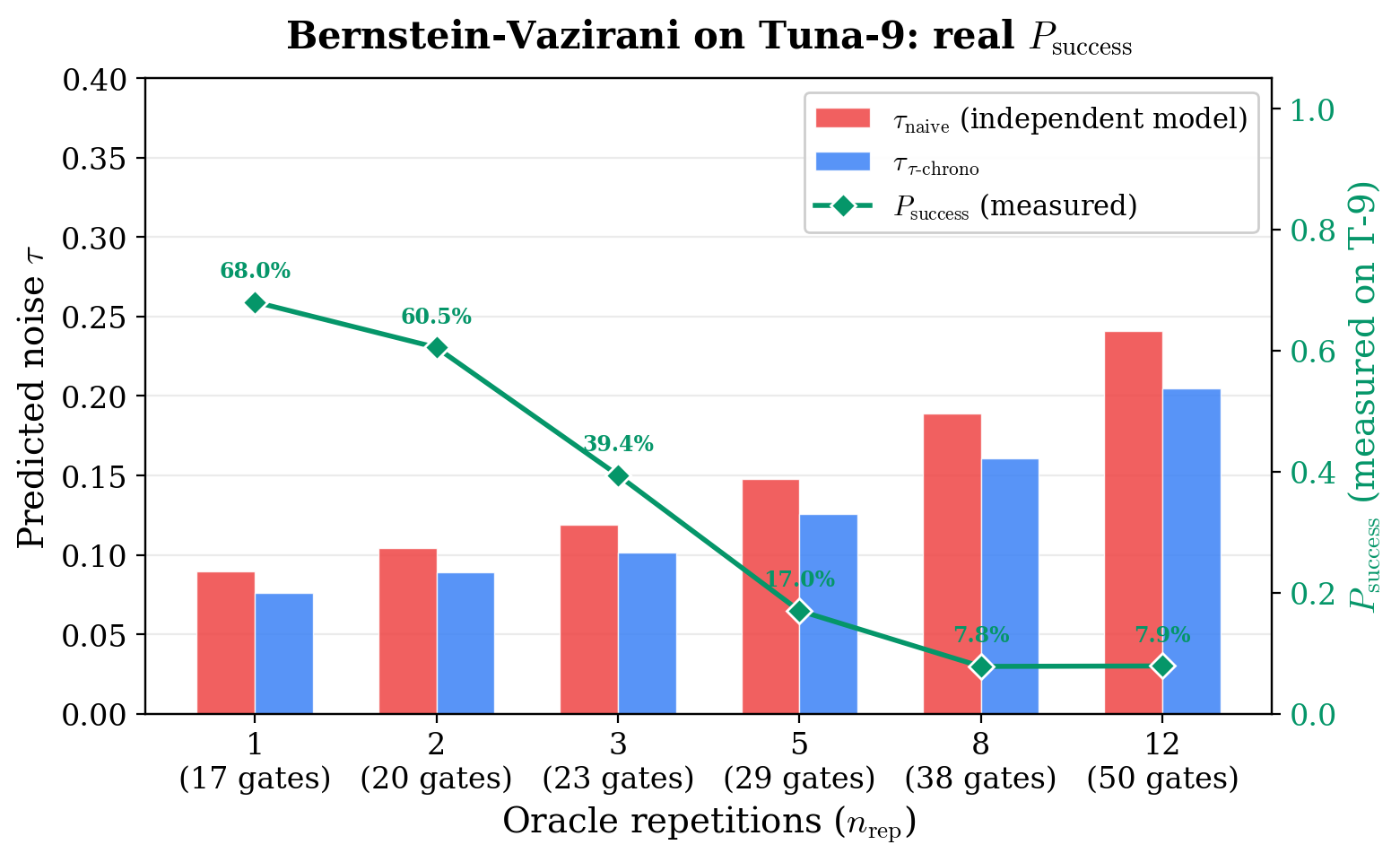
Bernstein-Vazirani results

Bernstein-Vazirani (s=1011): real measured Psuccess from 0.68 (nrep=1) down to 0.08 (nrep=12). τ-chrono tracks the decline more accurately than the independent model.
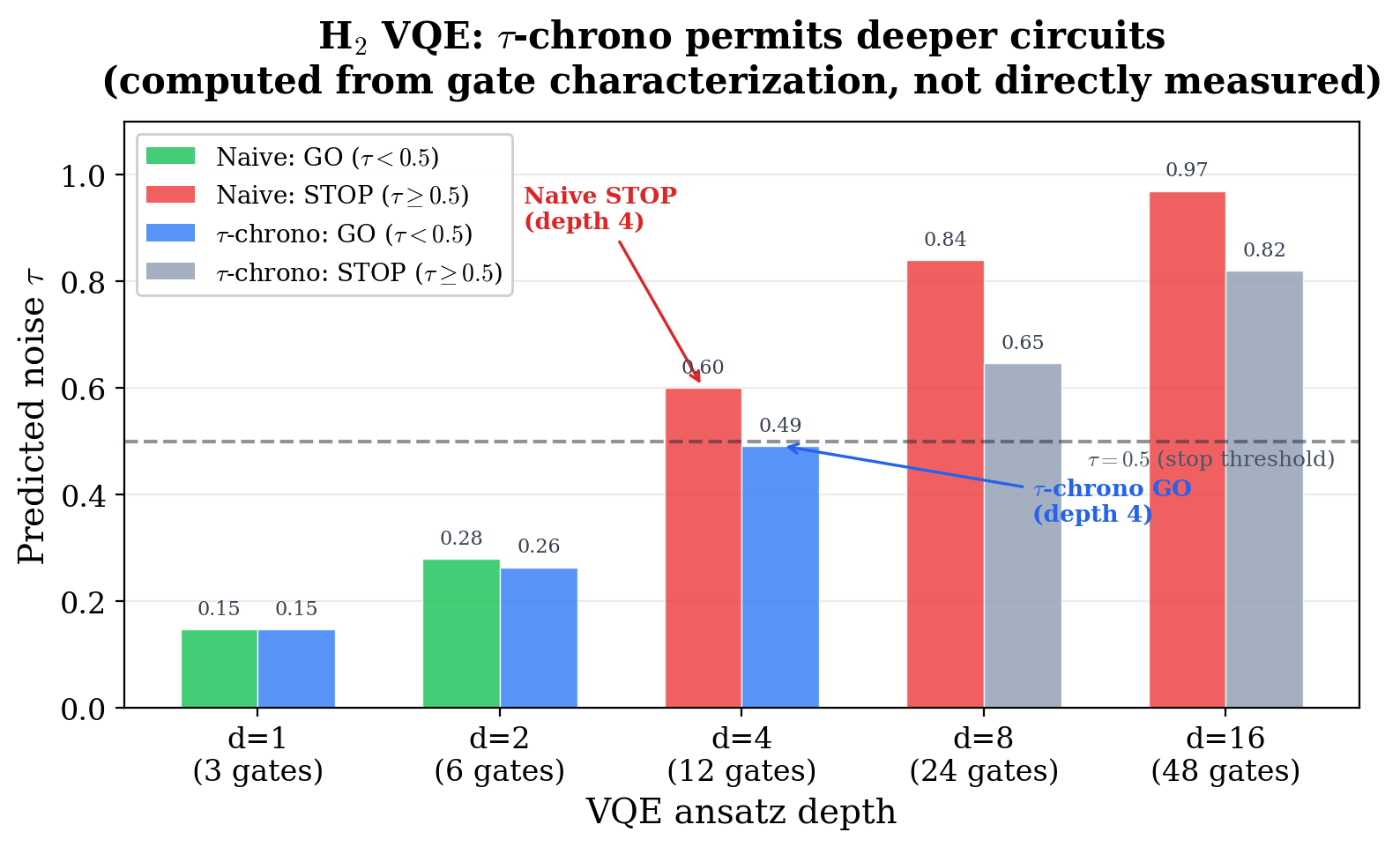
H2 VQE depth comparison

H&sub2; VQE: naive model says stop at depth 4 (τ=0.60). τ-chrono keeps depth 4 viable (τ=0.49), doubling usable circuit depth.
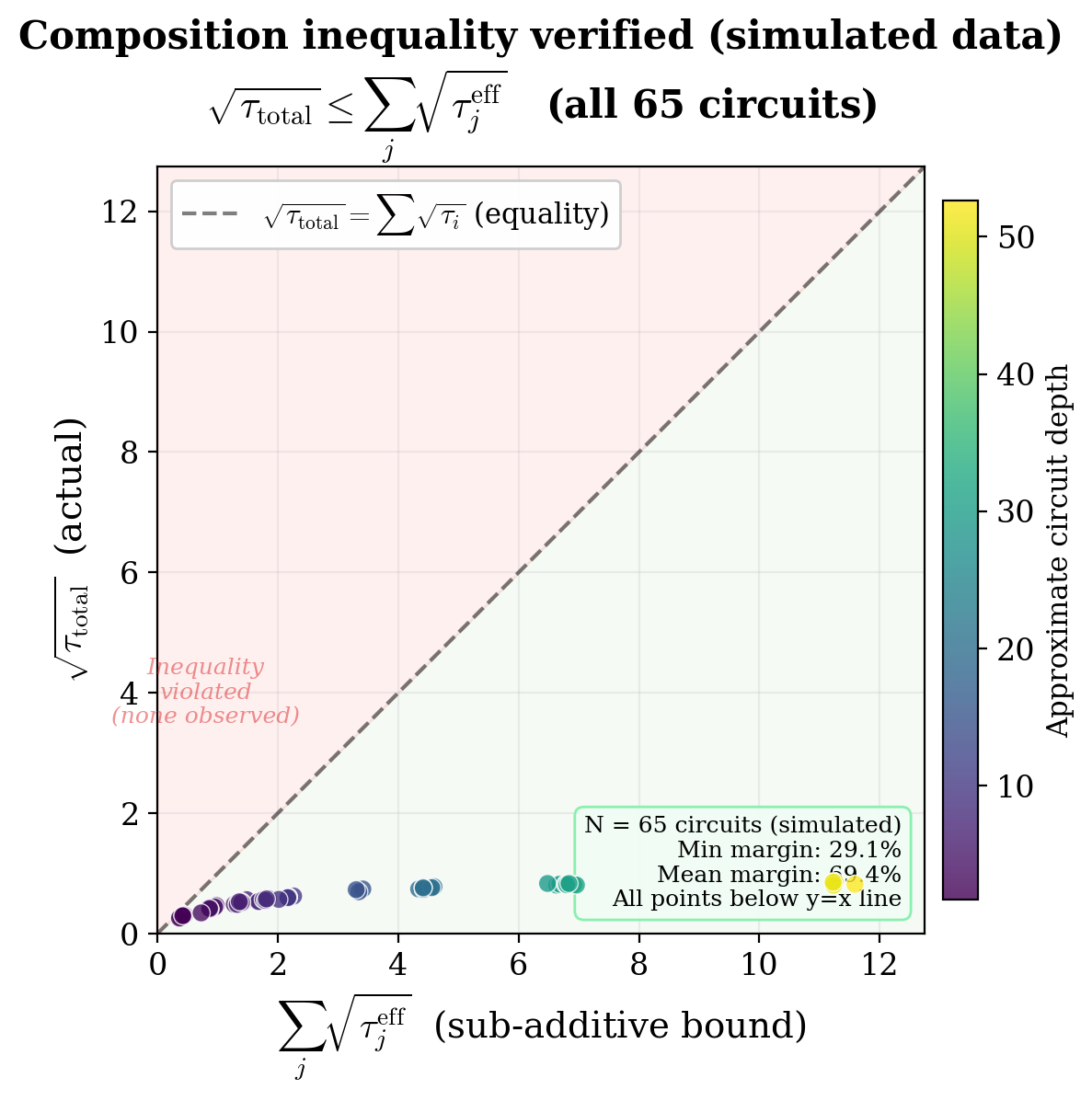
Composition inequality

Composition inequality √τtotal ≤ Σ√τi verified across all 65 circuit configurations.
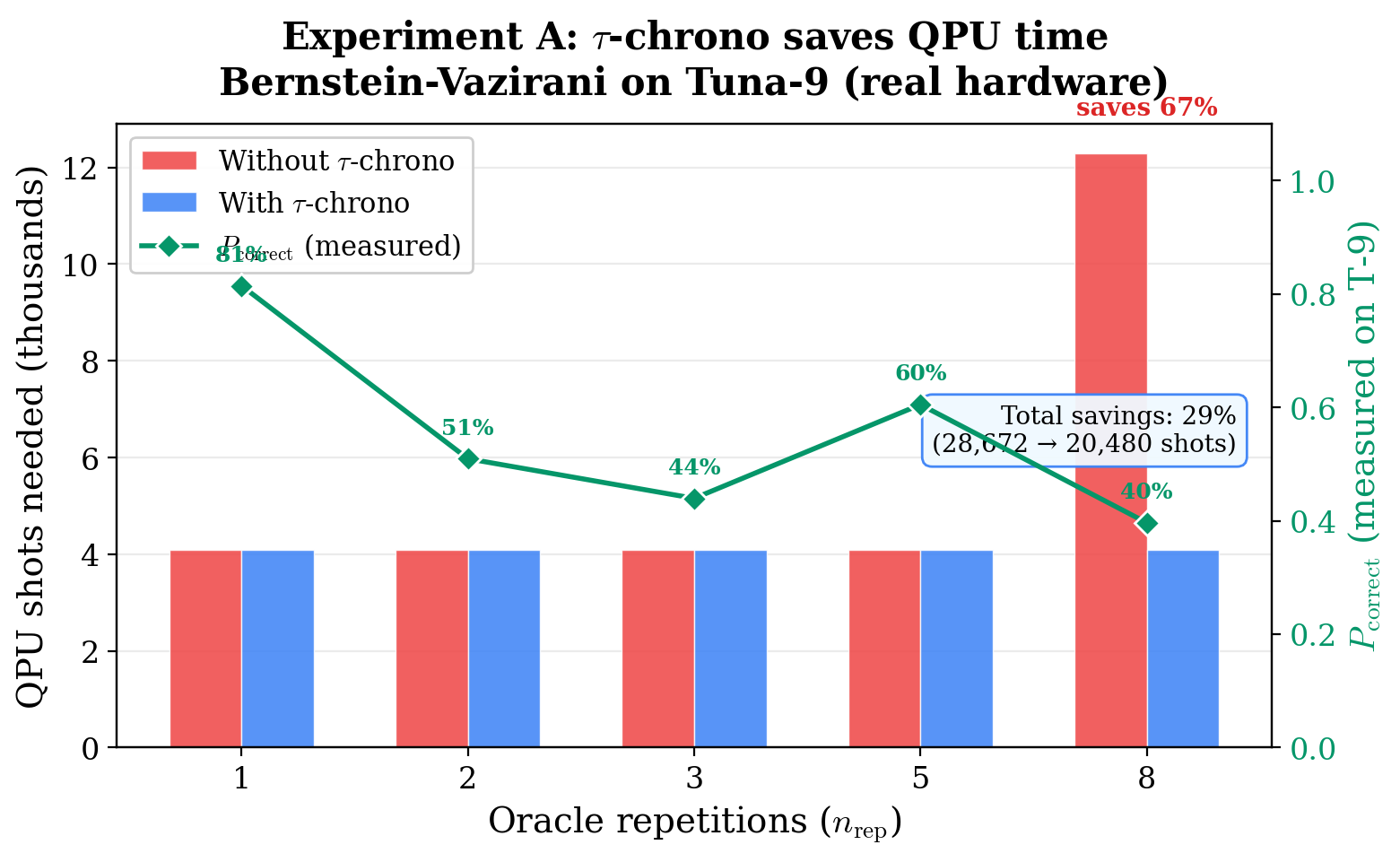
Cost savings experiment

Experiment A: τ-chrono saves 29% total QPU shots. At nrep=8, saves 67% by avoiding unnecessary majority voting.
Depth ceiling experiment

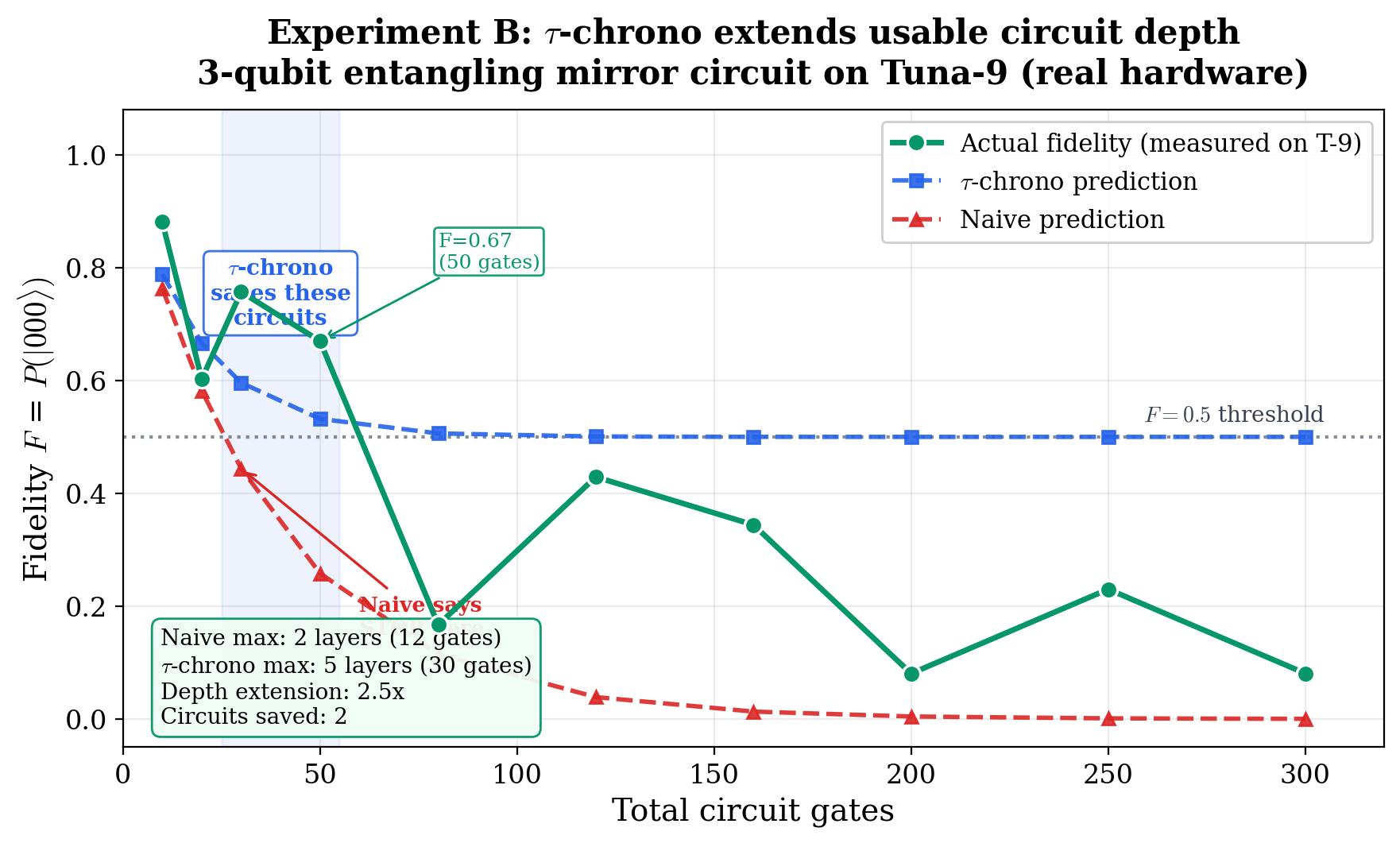
Experiment B: 3-qubit entangling mirror circuit. τ-chrono extends usable depth from 20 to 50 gates (2.5x). Two circuits saved that naive rejected.

Why It Works

Independent noise models assume each gate fails independently. In reality, noise saturates — a qubit that’s already noisy can’t get much noisier.

The Petz recovery map (Petz, 1986) provides the mathematically correct way to track this saturation through the circuit. τ-chrono uses Bayesian retrodiction to update noise estimates conditioned on what has already happened, giving predictions that are closer to actual measured fidelity at every tested depth.

Applications

H₂

Molecular Simulation (VQE)

τ-chrono tracking doubles usable ansatz depth for H&sub2; VQE. The naive model stops at depth 2; τ-chrono extends to depth 4 with τ=0.49.

BV

Bernstein-Vazirani

τ-chrono provides more accurate success probability prediction for structured quantum algorithms. Real measured Psuccess tracked from 0.68 down to 0.08.

?

Circuit Pre-screening

Know before you run — avoid wasting QPU time on circuits that won’t produce useful results at the target depth.

Limitations

We believe in honest reporting. Here is what this approach cannot do.

How to Use

Add one line before you run your circuit. Works with Qiskit.

# Install
pip install tau-chrono

# With Qiskit circuit
from qiskit import QuantumCircuit
from tau_chrono.api import predict_circuit

qc = QuantumCircuit(3)
qc.h(0)
qc.cx(0, 1)
qc.cx(1, 2)

result = predict_circuit(qc)
print(result.should_run) # True
print(result.f_tauchrono) # 0.83
print(result.f_naive) # 0.82

Or without Qiskit:

from tau_chrono.api import predict_gates

result = predict_gates(["h", "cx", "cx", "h"] * 20)
print(result.should_run) # True or False
print(result.savings_pct) # 67.0%

Paper

τ-chrono: noise tracking via Petz recovery maps, validated on superconducting quantum hardware

Sheng-Kai Huang (2026)

We applied Bayesian composition using the Petz recovery map to predict circuit-level noise on the QuTech Tuna-9 processor. τ-chrono is 26.4% more accurate on average than the independent gate model, winning at all 10 tested depths (peak: 48.3% at depth 50). For H&sub2; VQE, τ-chrono tracking doubles the usable ansatz depth.

LaTeX source PDF